

For better or worse, Doctor Who: Joy to the World is the quintessential Steven Moffat story in most respects. Thankfully, there is more better than worse. Unfortunately, there is also a heavy sense of deja vu that has nothing to do with the story’s frantic pace and jumping from one time to another.
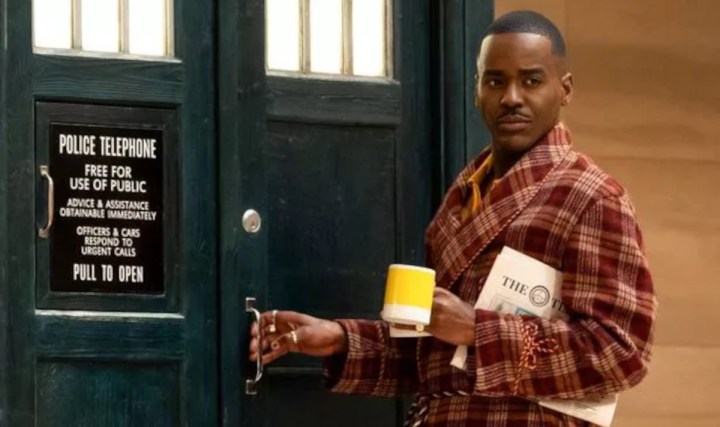
The story opens with the Doctor traveling solo and making use of the condiment station in a fancy hotel. Specifically, the Time Hotel, which allows patrons to visit historical inn rooms in a variety of time periods. (Why is the Doctor there? Because for all the many rooms in the TARDIS, he reportedly has no fridge and it’s the easiest way to get fresh milk for his coffee.)
This side-trip leads the Doctor to notice a mysterious briefcase, which gets handcuffed to a succession of owners before becoming attached to a woman named Joy in 2024. Something about the briefcase causes people to zone out, repeating the same parroted phrase about a star seed. Solving this mystery leads the Doctor on a long and circuitous journey with the fate of the world and Joy’s life in the balance.
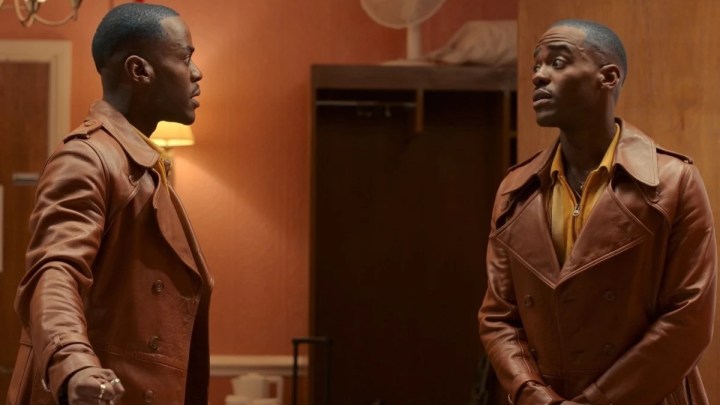
Moffat recycles a number of favorite story elements throughout Joy to the World. People defying death as AI? The Doctor bootstrapping the code he needs to disarm a doomsday device? The Doctor having trouble saying goodbye to companions? The Doctor arguing with himself? We saw these ideas throughout the Matt Smith and Peter Capaldi eras and the script for Joy to the World doesn’t do much to vary them up.
Thankfully, while the base plot elements are familiar, Moffat can still write genuine human emotion like few Doctor Who writers ever did. There are a lot of honestly touching moments amid all the insanity.
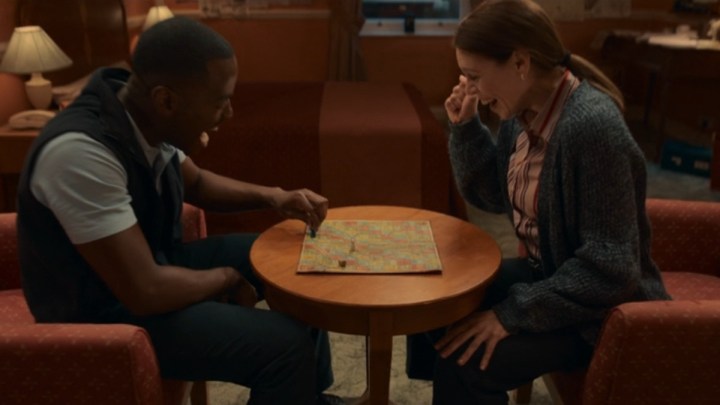
Chief among these is the interaction between Ncuti Gatwa and Steph De Whalley, who plays Anita – the hotel manager with whom The Doctor spends a happy year living a normal life while waiting for a time portal to open. Their performances help sell the moment, so die-hard Whovians are unlikely to notice how familiar it seems until after the credits are rolling. Nicola Coughlan fairs less well as the titular Joy, basically playing Donna Noble but with perky cluelessness rather than belligerent confusion. Her performance is not bad, but the script doesn’t give her much to do.
Technically, the episode is top-notch. The special effects work is solid, with good CGI for the monsters and the familiar Silurian make-up looking fantastic. The varied sets and costumes are well made and truly look like what they should look like. The use of vivid colors in the backgrounds throughout is also notable.
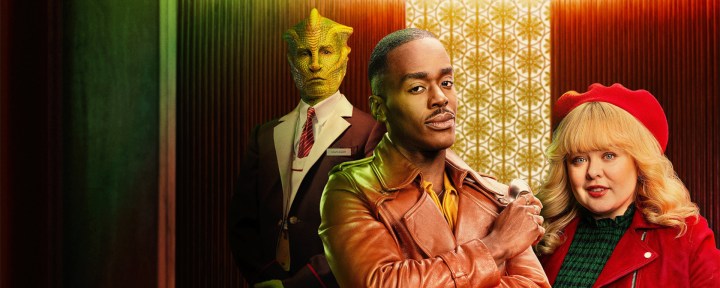
All in all, Joy to the World is a serviceable Christmas special. It isn’t the best Doctor Who story ever, but it is also far from the worst. And there are far worse things for even Steven Moffat to write than an episode that reminds you of his best work.


 Kabooooom!
One thought on “DOCTOR WHO: JOY TO THE WORLD [Review]”