
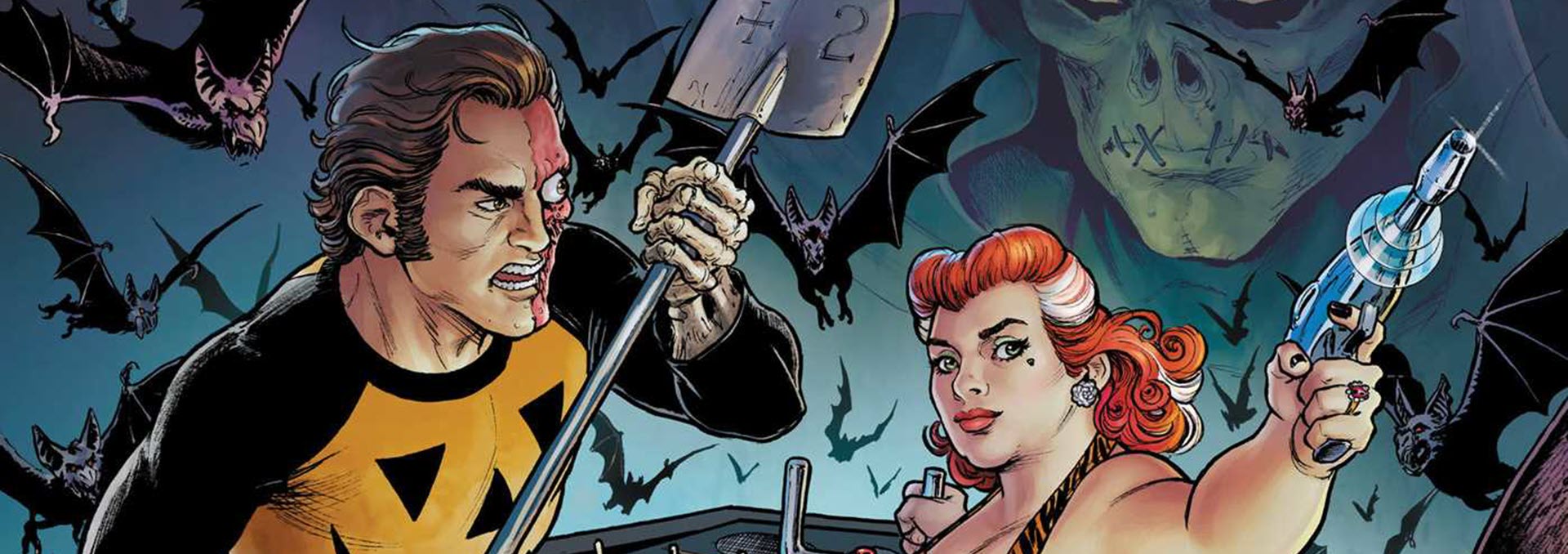
Drew Edwards created the character of Halloween Man in 2000. The award-winning series blends horror and superheroes to spin stories that are everything that makes comics a unique artform. Where else can you see a half-undead pulp writer and his super-scientist girlfriend saving the world from the weirdness mainstream heroes won’t touch? Nowhere we can think of. And we looked!
Recently, Kaboooom Editor-in-Chief Matt Morrison sat down with Edwards to ask him about Halloween Man at 25 and other questions about life, comics, horror, and superheroes.
What inspired Halloween Man?
I’ve always been drawn to monsters. As a kid, I loved Frankenstein, the Wolf Man, all those old
creature features. But the real spark for Halloween Man came from tragedy. When I was
nineteen, I lost my twin sibling in a car accident. It shattered me. I was dealing with survivor’s
guilt, depression, and feeling like I didn’t fit in anywhere. It was like a Halloween costume I could
never take off.
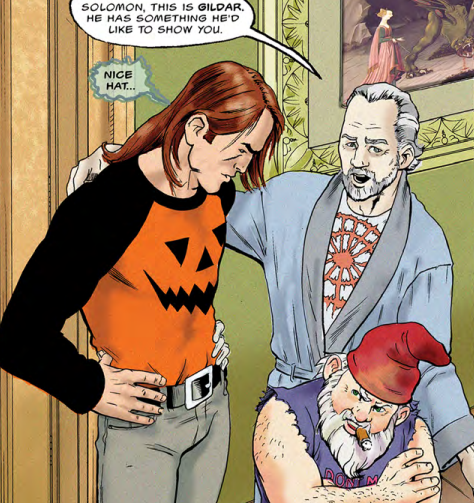
Solomon Hitch, the Halloween Man, grew out of that grief. He’s part-dead, scarred, and strange,
but he still wants to do good. That was me trying to make sense of my own pain — to tell myself
that even if you’re broken, even if you feel like a monster, you can still be the hero of your own
story.
So Halloween Man is both a love letter to horror and superheroes, and a very personal way of
working through my demons. It’s about otherness, it’s about love, it’s about survival. At its core,
it’s me saying: even monsters deserve a happy ending.
They say every character has a little of their writer in them. Given he’s a pulp writer when
he’s not doing the superhero thing, how much of Solomon is you?
Well, originally Solomon wasn’t meant to be autobiographical. He was my take on a Jack
Kirby–style ‘monster hero’ — very much in the spirit of Ben Grimm, but filtered through a layer of
punk rock attitude. So yeah, I still kind of wince when people call me ‘Halloween Man’ at
conventions.
That said, the character started out as a kind of creative therapy for me after some heavy
trauma, and he very quickly picked up a lot of my personality quirks. More than any other
character I’ve written, really. So I’d say Solomon is me at my grouchiest. The big difference is
he’s a lot quicker to throw a punch than I am these days… which is probably for the best.
For that matter, are any of the characters modeled on your friends and family?
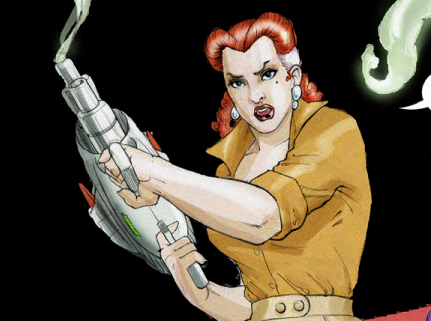
Oh, absolutely. I think most folks who’ve followed my work know that Lucy is very much
modeled on my wife, Jamie. The funny thing is, Lucy existed before I ever met her. Then I meet
this person who just happens to embody so many of Lucy’s traits — the brains, the boldness,
and, let’s be honest, the curves — and suddenly life felt like it was cosplaying my comic. Lucy
was already my idealized vision of womanhood, so of course I went and married someone who
checked all those boxes. Art imitates life, and then life imitated the art right back.
Bella, on the other hand, is based on my late twin. That one cuts deeper. My twin was a trans
woman, and Bella was her chosen name. The character’s look and power set are even borrowed from a superhero RPG character she created. Writing Bella is my way of keeping her
in the world, of making sure she still has adventures — even if they’re on the page instead of in
person. It’s my little act of resurrection magic. Sad as hell, but also kind of beautiful.
Other characters? They’re more like Frankenstein’s monsters stitched together from people I’ve
known. Man-Goat, for example, is a composite of several friends — a little bit of this guy’s wit, a
little of that guy’s stubbornness, and a lot of the working-class cool I’ve always admired.
Basically, he’s the drinking buddy you wish you had, except he’s part goat. So yeah, my comics
are basically one big family album — just with more vampires, robots, and eldritch slime.
Favorite superheroes? Apart from Halloween Man, of course!
The Fantastic Four are the gold standard for me — and Ben Grimm, the Thing, is my guy. He’s
been my favorite since I was a little kid. There’s just something about a big, grouchy,
rock-covered monster who also happens to be the emotional core of Marvel’s First Family. I
mean, come on — that’s basically the blueprint for Halloween Man right there.
Over at DC, I’ve always had a soft spot for the Doom Patrol, especially Cliff Steele, Robotman.
Another guy trapped in a body that doesn’t feel like his own, cracking wise to mask the pain.
You might be sensing a theme here. And yes, I’ll admit it: I am a huge Guy Gardner fan. Yeah,
he’s the Green Lantern everybody loves to hate, but I’ve always found something endearing in
his bullheadedness. Seeing him pop up in the new Superman movie made me ridiculously
happy — like watching an old friend get a cameo on TV.
I guess I’ve always been drawn to characters who are a little rough around the edges — tough
guys and so-called jerks who actually have massive hearts under all that damage. That feels…
relatable. But the flipside is I’m also a sucker for the super-scientists. Doc Savage, Tom Strong, Reed
Richards — the kind of characters who can save the world with brains instead of brawn. That’s
obviously where Lucy Chaplin comes from: my love of science heroes, filtered through a punk
rock, retro-futuristic lens.
And then there’s the weirder stuff. I adore the oddball indie heroes like Flaming Carrot and The
Tick. I think that’s because I love superheroes in all their forms — from the cosmic to the
comical. To me, the genre’s big enough to hold the Thing, Guy Gardner, Reed Richards, and a
dude with a flaming carrot for a head. That’s the beauty of it. Superheroes are a sandbox for
both tragedy and absurdity, and I like playing with both
Favorite supervillains?
Oh, that’s an easy one: Doctor Doom. Everything about him is perfect — the design, the
melodrama, the Shakespearean monologues. He’s a walking opera in green and metal.
What makes Doom so fascinating is that he’s both impossibly grand and embarrassingly small
at the same time. He projects this regal, world-conquering power, but his core motivation is the
pettiest human emotion imaginable: jealousy. Everything he does, every scheme, every
invasion, every robot duplicate, boils down to one thing — he cannot stand that Reed Richards
is smarter, more respected, and has the life Doom thinks he deserves. ‘How dare Reed
Richards have a loyal best friend, a brilliant,HOT, wife, and a skyscraper in Manhattan! All of
that should rightfully belong to DOOM!’
And the best part? He speaks in third person like he’s his own hype man. That booming,
larger-than-life delivery isn’t just a quirk — it’s his way of willing himself into godhood, of
demanding the world see him as bigger, brighter, more important than everyone else.
But here’s the kicker: for all his ego, Doom can actually back it up. He’s terrifyingly competent.
He’s built time machines, stolen the power of gods, conquered entire dimensions. If he could
just get over himself — just once — he’d probably be unstoppable. But he can’t. He’s his own
worst enemy. Which is why, despite everything, he’s still weirdly relatable. Doom is the genius
who keeps tripping over his own ego, and that’s what makes him the greatest villain of them all!
Favorite Universal Horror monster?
Another easy one: Larry Talbot, the Wolf Man. Dracula and Frankenstein’s Monster came from
the pages of books, but the Wolf Man is pure Hollywood invention — and in many ways, the
embodiment of Universal’s ethos: powerful, tragic, and terrifyingly human.
Larry is fascinating because he’s a monster who suffers in plain sight. He’s like someone with a
terminal illness — but instead of killing himself, the illness kills everyone around him. There’s a
deep sadness in that, a sense of inescapable doom. Every time he transforms, it’s not just a
physical thing; it’s a psychological purge. You’re seeing a man wrestling with rage, guilt, and fate
itself. And yet, he keeps going. Lon Chaney Jr. gave him such weary dignity that you can’t help
but empathize, even as he tears through the night.
Then there’s the occult angle, which I love. In the original lore, the curse is more than a bite —
it’s almost spiritual, a dark inheritance. Talbot’s lycanthropy isn’t just a mutation; it’s a cosmic
punishment, a collision of moon cycles, superstition, and human hubris. Every full moon, he
becomes a literal force of nature, and yet he’s still painfully tethered to the human world he can
never fully inhabit. That duality — the monster and the man — is why we keep coming
Favorite horror movies of all time?
Ah, that one’s brutal — my answer literally changes by the hour. But today, I’ll play it safe and go
with a tie: King Kong and Evil Dead II. One’s a towering classic of epic adventure and primal
terror, the other is pure, gleeful chaos — so I get the best of both worlds. It’s my little
cross-genre cheat: giant monsters meet over-the-top gore, and I get to feel cultured and trashy
all at once.
Are you reading any comics regularly right now?
Not really. These days, I mostly stick to trades and back Kickstarters from creators I admire.
Weekly trips to the comic shop? Forget it. I’m trying to raise a kid and fund my own work — my
free time isn’t exactly Marvel-level abundant.
I’ve also become a bit of a stick-in-the-mud. I buy a lot of Silver and Bronze Age stuff in
collected editions because that’s what I genuinely love. Even then, most of it just sits on my
shelf until I find a rare moment to breathe — it’s like having a library full of treasure you can’t
open without guilt.
That said, I still keep an eye on a few modern gems. Ryan North’s run on Fantastic Four is
fantastic, I adore Asssian Roommate by my friend Monica Gallagher, and my buddy Dan Price’s
Bigfoot Knows Karate is pure joy. Beyond that… I’m embarrassingly out of touch with what’s
‘hip’ in comics these days. Let’s just say I’m a proud Bronze Age time traveler stuck in a digital
world.
Favorite comic series of all time?
Hands down, it’s Stan Lee and Jack Kirby’s Fantastic Four. I will die on that hill. And I mean die
— I’ll arm wrestle you at a convention if you disagree, preferably while wearing a Thing mask.
No other series in the history of superhero comics has introduced as many new concepts,
villains, or characters over such a sustained period. They didn’t just tell stories; they invented
entire worlds, complete with rules, mythology, and a sense of cosmic scale that still feels fresh
today.
Beyond the sheer creativity, the Fantastic Four run is a masterclass in character dynamics.
Reed Richards, the cerebral leader; Sue, the moral and emotional anchor; Johnny, the chaotic
wildcard; and Ben, the gruff, tragic heart — they were flawed, relatable, and distinct in ways that
modern comics still struggle to match. People really ought to study it as a blueprint for
world-building and ensemble storytelling. Every issue is a lesson in pacing, invention, and how
to make a family feel real even when one of them is literally a rock monster.
Plus, it’s endlessly fun. Cosmic rays, interdimensional battles, hidden kingdoms, giant monsters
— it’s like a graduate course in imagination disguised as a comic book. If you can read that run
without being inspired and entertained by Jack Kirby’s power-fists-of-doom art style, I’ll personally refund your comic-buying career. It’s the perfect combination of genius, chaos, and sheer heart, and it’s never, ever not relevant.
Favorite comic writers?
Grant Morrison is my all-time favorite writer, not just in comics, but in any medium. Their Doom
Patrol run is absolutely seminal for me — it was weird, heartfelt, and so unapologetically itself
that it actually helped me through some of the darkest times in my life. Morrison showed me
how to filter all my Silver Age influences through a modern lens without losing their soul. They
gave me permission, in a way, to embrace both the surreal and the sincere at the same time.
I’m also a huge fan of Keith Giffen and J.M. DeMatteis’s Justice League run. Honestly, it’s
probably the most realistic take on superheroes I’ve ever read. Not because of the powers, but
because of the personalities. Comedy is honest. In my experience, even in the most dire
situations, people are still cracking jokes, dropping quips, or ribbing each other. That’s just life.
And Giffen and DeMatteis nailed that balance — world-ending stakes and banter that feels like
you’re actually in the room with your funniest friends.
Then there’s Steve Gerber, who feels like the connective tissue between those approaches — a
writer who combined biting humor, unrestrained weirdness, and genuine emotion. Reading
Gerber always felt like you were on a carnival ride where the floor might drop out at any second,
but you were laughing too hard to care.
So yeah, if you mash those three together — Morrison’s cosmic vision, Giffen and DeMatteis’s
razor wit, and Gerber’s anarchic weirdness — you basically get my personal comics bible. They
taught me that stories can be absurd and profound, hilarious and heartbreaking, all in the same
breath. And honestly, that’s the kind of writing I aspire to myself.
Favorite comic artists?
Okay, so if we’re excluding the insanely talented folks I’ve actually worked with — because
otherwise this list would just be me brown-nosing my collaborators — let’s talk about the giants.
First up: Dave Stevens. I was lucky enough to be email buddies with him for a few years, which
still blows my mind. We weren’t close in the “let’s hang out every weekend” sense, but still, I got
to talk art and comics with Dave freakin’ Stevens. The guy was a master of line, form, and
retro-glamour, and somehow also one of the kindest humans in the industry. Every time I revisit
The Rocketeer, I’m reminded how effortless he made it look. Spoiler: it was not effortless.
Richard Case is another big one for me. His collaboration with Grant Morrison on Doom Patrol
didn’t just “work” — it redefined what superhero comics could look like. His clean lines and
surreal staging made Morrison’s fever-dream scripts feel grounded, while still keeping them
gloriously weird. Without Case, Doom Patrol might’ve just been chaos. With him, it was beautiful
chaos.
Jack Cole’s Plastic Man? Forget it. That’s cartooning at its absolute peak. The elasticity, the
slapstick, the inventiveness — Cole treated every panel like an opportunity to break the laws of
physics and the rules of the page. It’s a masterclass in making comics do things no other
medium can.
Then you’ve got Mike Allred. Madman was my gateway to realizing that the “Neo-Silver Age”
could be a playground rather than a museum exhibit. Allred’s pop-art sensibilities helped me
visualize what the world of Halloween Man could look like — colorful, bold, unapologetically
stylized. His work feels like someone turned a rock concert into a comic book.
And of course, we have to bow to the trinity of Marvel greats: Jack Kirby, Steve Ditko, and John
Romita Sr. Kirby didn’t just draw superheroes — he created mythology. The man basically built
a new visual language for action, motion, and raw cosmic power. Ditko brought this eerie,
off-kilter energy, whether he was doing Spider-Man’s urban acrobatics or the psychedelic realms
of Doctor Strange. And Romita Sr.? He brought warmth and humanity. He drew people you
wanted to know, not just heroes you wanted to watch punch things. Together, those three
basically set the blueprint for everything that came after.
So yeah, if you force me to choose: Kirby is the god of thunder, Ditko is the strange sorcerer in
the corner, Romita is the heart, Stevens is the stylist, Case is the dreamweaver, Cole is the
trickster, and Allred is the cool older cousin who takes you to a midnight movie and changes
your life. That’s the pantheon I worship at.
You recently became a father. Obviously, that’s changed your life but has it changed your
writing at all?
Becoming a dad hasn’t dulled my edge for horror one bit — if anything, it sharpened it. Some of
the most graphic, blood-soaked pages I’ve ever written have come after Luna was born. I’m
knee-deep in a new slasher project called The Matron with David Bowles, Monica Gallagher,
and Harry Saxon, and it’s about as far removed from Halloween Man as you can get. It’s grim,
it’s cynical, it’s wall-to-wall grue — and that’s been cathartic, honestly. It lets me pour out the
darker, more pessimistic side of myself that wouldn’t belong in Solomon’s world.
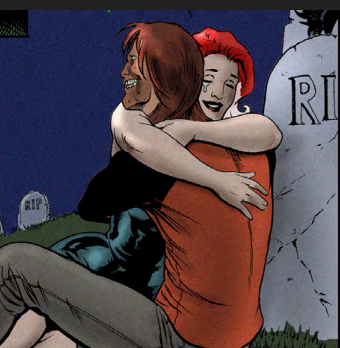
Because here’s the thing: Halloween Man has always been, at its core, a love story. It’s a horror
comic, sure, but it’s also romantic and weirdly hopeful. And becoming a father — yeah, that’s
absolutely shifted the way I approach Solomon. I’ve started writing him with more peace, more
acceptance of himself. He’s still a monster, still rough around the edges, but he’s not at war with
his own existence in quite the same way.
That change comes straight from Luna. When my daughter looks up at me, she doesn’t see a
monster, or a cynic, or someone who spent years doubting himself. She just sees her Papa, and
in her eyes, that’s someone worthy of love. That’s a powerful mirror to look into every day. It’s
given me permission to let Solomon believe the same about himself — and maybe, by
extension, it’s teaching me to believe it too.
Weirdly, becoming a father has also made me angrier at the current state of the world. Because
now it’s not just about me — I want my daughter to grow up in a safe world where everyone is
valued. That anger seeps into both of my works, but in different ways: in The Matron it’s raw,
bloody rage, and in Halloween Man it’s a defiant insistence on hope, love, and justice, even in
the face of monsters.
So has fatherhood changed my writing? Yeah. It’s made my horror darker, my monsters
scarier… but it’s also made my love stories stronger — because at the end of the day, both of
those things are for her.
Can we expect a Halloween Baby for Lucy and Solomon at some point?
This is hands-down the most-asked question of 2025. I can’t go to a con, do a signing, or hop
on a podcast without somebody asking me when Lucy and Solomon are going to have a kid. It’s
right up there with “when’s the next issue coming out?”
So here’s the deal: yes, it’s going to happen. But probably not as quickly as people would like. I
still have to get to the wedding issue first — and at the admittedly slow, snail-crawl pace I’ve
been releasing things, that might take a minute.
But trust me, when the baby arrives in the story, it won’t be subtle. You’ll know it. There’ll be
signs. Look to the moon for hints.
Describe your collaboration process with your artists. Do you write specific stories for
specific artists you work with that cater to their strengths?
Look, nobody’s pulling down Big Two rates on Halloween Man, so I do my best to make the job
fun. My philosophy is: if I can’t pay you like Marvel, I can at least make sure you’re having a
blast.
Usually, I’ll throw a few scripts an artist’s way and let them pick the one that sparks joy — or at
least mild enthusiasm. If an artist loves cheesecake, odds are they’ll grab a Lucy-centric story. If
they’re into monsters and mayhem, Solomon’s their guy. It all balances out: people get to draw
what excites them, and the comic gets made by someone who’s genuinely into the material.
Plus, everybody’s happier when I don’t force a “draw 30 horses in the background” page on
them.
You did a school shooting story. Was there any negative backlash from that?
Surprisingly, no. In fact, that story actually helped me win an award. You’d think, given how
polarized everything is these days, that it would have drawn fire from one side or the other. But
it seems like people across the spectrum understood what I was trying to do.
I think a big part of that is the work I put in beforehand. I did a lot of sensitivity reads — I mean,
a lot — with people from very different walks of life, and I took their feedback seriously. That
shaped the story as much as my own perspective did.
Halloween Man can absolutely veer into the sensational at times — it’s a pulp horror superhero
comic, after all — but I knew this story couldn’t be that. I wanted it to be shocking, yes, but more
than that, I wanted it to be sobering. A moment where the comic pauses, looks at the real world,
and says: “this matters.
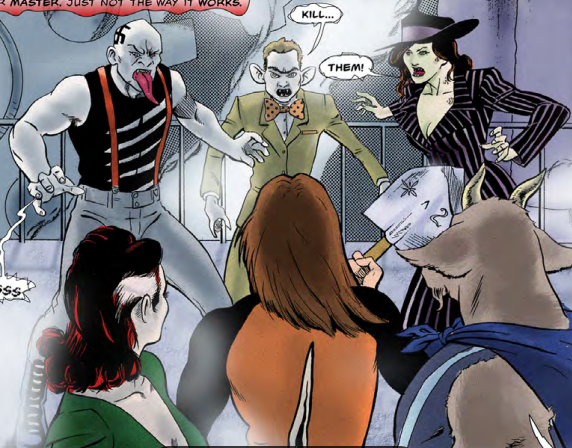
Is Solomon named after Solomon Kane?
That’s a sharp observation—and absolutely correct.
What’s next for Halloween Man? In one word.
Chorus.
You have a collection coming out with Simon and Shuster. How did that come into being?
I met Scott Chitwood from Red 5 Comics at Comicpalooza in Houston, and we immediately hit it
off. He was looking to expand his horror line, and I was looking for a print partner to help grow
the Halloween Man brand. The timing couldn’t have been better, and it felt like a natural fit.
The character has always had untapped potential, and with the 25th anniversary coming up, it just
seemed like the right moment to bring Halloween Man to a wider audience and give longtime
fans something special. Our goal has always been to grow the character beyond his cult
following, and this collection with Simon & Schuster is a big step in that direction.
Apart from the new one, what one book would you recommend to promote Halloween
Man?
I’d recommend Hallowtide. Honestly, I think it’s one of the best things I’ve ever written, and it
captures the spirit of Halloween Man like nothing else. It’s the most “Halloweeny” story in the
series—full of monsters, creepy settings, and that mix of humor and horror that fans love. For
anyone new to the character, Hallowtide really showcases what makes Halloween Man unique:
his battles against the supernatural, his cleverness, and the wild, fun energy of the world he
inhabits. It’s a perfect entry point for readers and a great way to introduce more people to the
character as we continue growing the brand.
Any final thoughts for our readers?
We’re living in dark times, and more than ever, art matters. Pop culture matters. Comics matter.
Treasure this incredible medium with the people you love, and never let anyone silence your
voice. I say this as a middle-aged white redneck, but the truth is we need all voices—people of
color, queer voices, immigrants, everyone. Go out and make art. Especially make comics,
because comics have always been a place for the disenfranchised, a place to tell stories that
might otherwise go unheard. Be your own superhero.
Halloween Man is now avaialble at bookshops, GlobalComix, and comic shops everywhere.

 Kabooooom!