

SPIDER-MAN/HULK: FIRE & BRIMSTONE #1 / Script by KEVIN SMITH & ANDY MCELFRESH / Art by R.B. SILVA / Colors by FEDERICO BLEE / Letters by VC’s ARIANA MAHER / Published by MARVEL COMICS
Despite being co-written by Andy McElfresh, Spider-Man/Hulk: Fire & Brimstone may be the most Kevin Smithesque book Marvel Comics has ever published. I admit this is a bold statement given we had an officially sanctioned Jay and Silent Bob/Marvel Universe crossover two months ago. However, I can defend it.
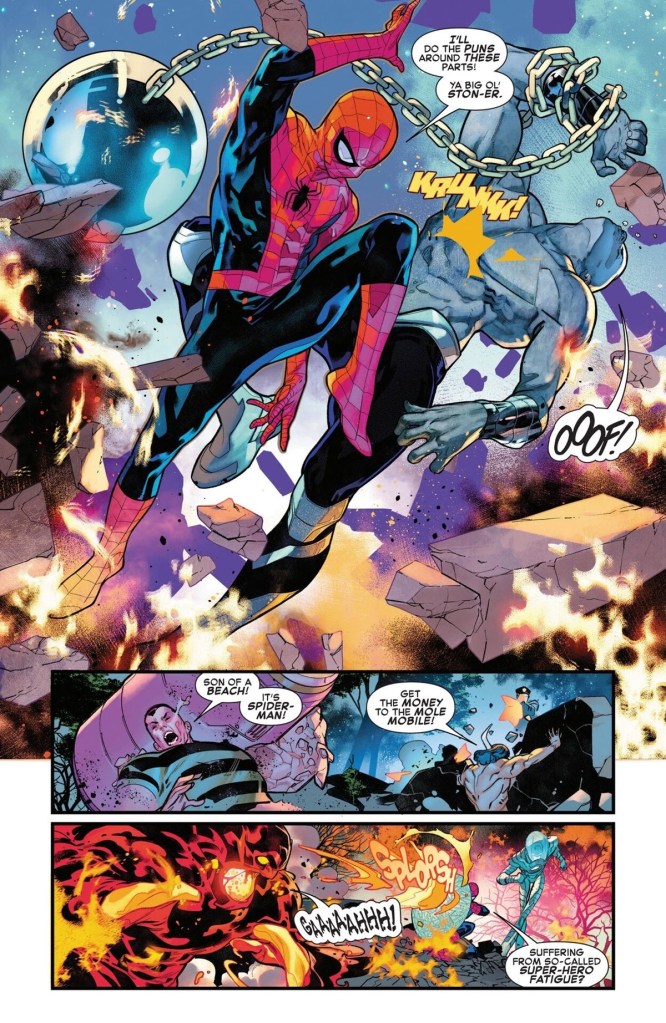
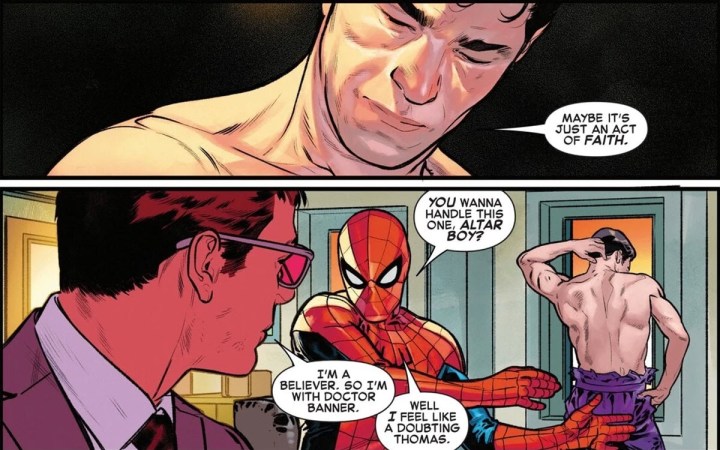
In truth, Spider-Man/Hulk: Fire & Brimstone is two comics. In the first, we have a supervillain smackdown, as a new supervillain group called The Manosphere attack an Easter Sunday mass organized by a popular Cardinal. This leads to a team-up of sorts between the Hulk and Spider-Man. In the second and much stronger story, Peter Parker and Bruce Banner (with an assist from Matt Murdock) discuss exactly why Hulk was there and have a deep talk about the power of faith.
Kevin Smith is a decisive creator for a number of reasons, and I say that as a fan. Most of his movies and comics have some serious thought behind them. His film Dogma, for instance, is one of the best examinations of faith on film. However, Smith’s points are often lost behind the dumb humor for smart people that is his hallmark. Such is the case here, with every villain in the Manosphere spouting bad puns relating to their powers and Spidey responding with dumber puns.
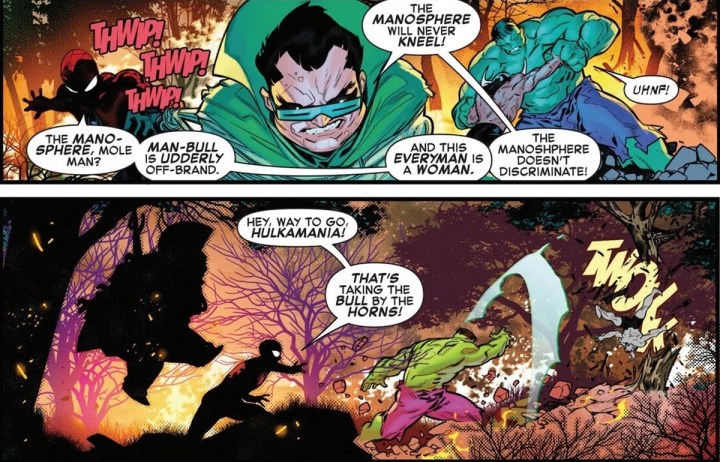
I should note are honestly some good gags in this. Mole Man’s continual reference to himself and his team in the third person is an easy laugh. Somewhat smarter is Spider-Man mixing Star Trek and Shakespeare with a nod to “Richard III: The Search for Spock.” Your mileage may vary as to whether it is worth enduring the pun-ishment for the good parts. But if you survived that last one I made, you can survive Spider-Man/Hulk: Fire & Brimstone #1.
The humor is dialed down in the second half, as Bruce Banner discusses how he’s turned to religion seeking ways to calm himself and control the Hulk. This is well in-keeping with some of the things he’d done under other writers, such as taking up meditation and yoga. It’s also somewhat ironic presenting the idea of the Hulk being a literal demon possessing Bruce, given the retcon that made gamma rays demonic and the Hulks the creation of the One Below All.

None of this is old history is referenced, nor does it need to be. But it’s a neat little detail for the Hulk fans. However, one wishes they’d played this somewhat straighter still. It’s also somewhat odd that Peter Parker is the one who questions how a scientist can turn to religion given Peter’s own portrayal of having some degree of faith and occasionally praying in his internal monologues.
In terms of art, the book is on firmer ground. R.B. Silva is one of Marvel’s most reliable artists, with a grounded sense of panel placement and story flow. There are a few panels where the scale of the Hulk seems a bit off, but that could be a reflection of how angry Bruce is at the moment. The colors by Federico Blee are consistent and varied well to indicate shade and texture. And VC’S Ariana Maher perfectly places the word balloons so as not to obscure the action.
Spider-Man/Hulk: Fire & Brimstone #1 is an interesting book, but one I ultimately think worth reading. The humor in the introduction may turn away some who have a low tolerance for Kevin Smith’s comedy. However, much as we may tolerate a world of demons for the sake of an angel, so too can we tolerate a deluge of puns for the sake of a golden story idea.


